The Double Diamond is Dying. Long Live the Skeleton.
There is a joke my dad used to tell me about a mathematician, an engineer, and a designer caught in a rainstorm.
The mathematician pulls out a notebook to calculate the exact angle and velocity they need to run to stay the driest. The engineer starts scouting for materials to build a waterproof shelter. The designer just takes their book, puts it over their head, and keeps walking.
The designer solved the human problem immediately.
In 2026, AI has turned everyone into a "builder," but it hasn't turned everyone into a problem-solver. As we move away from the rigid Double Diamond and toward high-speed models like the Stingray, we are at risk of losing the very thing that makes the designer and the 3-legged stool valuable: Purposeful Tension.
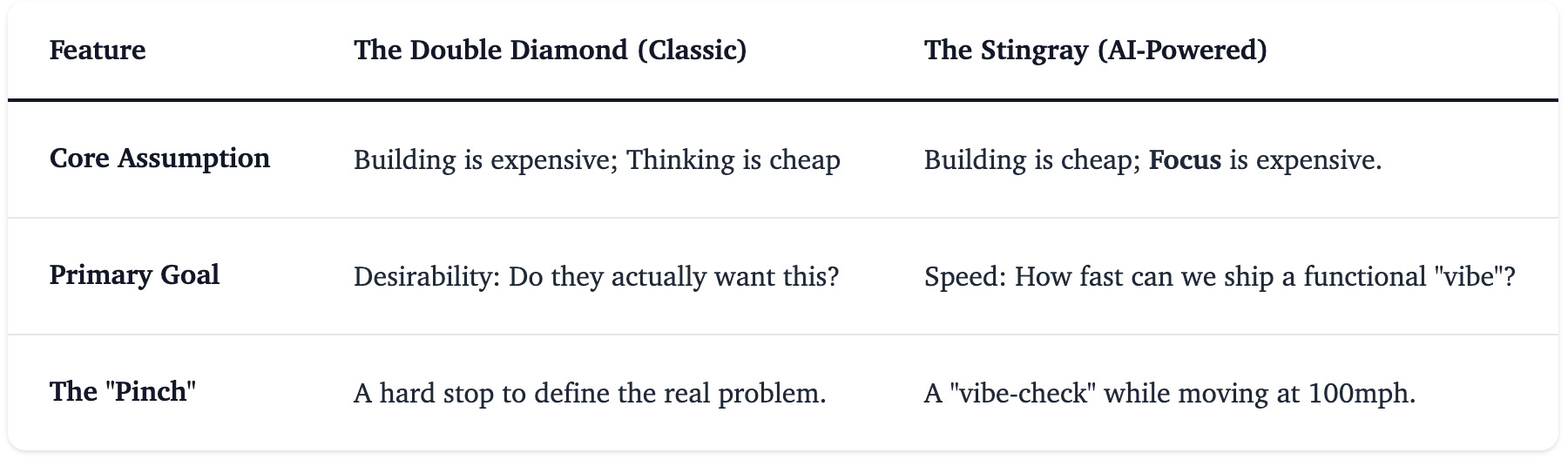
Scarcity vs. Abundance
The fundamental shift isn't about tools; it’s about what we consider "expensive."
The "Stingray" and the Trap of the Easy Build
The Stingray Model collapses the "Discover" and "Define" phases into a single body of "Train" and "Develop." While this makes execution nearly instantaneous, it offers no framework for how we actually define the problem.
Tamarah Usher calls this Process Collapse. The danger here isn't the speed; it's the lack of deep user understanding. When we use AI to "vibe-code" our way to a solution, we often skip the deep inquiry required to know if that solution actually matters. We risk optimizing a workflow that shouldn't exist in the first place.
Why the 3-Legged Stool Still Matters
I’ve always advocated for the 3-legged stool: a tight-knit partnership between Product, Design, and Engineering. We didn't need AI to "collapse" our roles; we just needed to work as a team.
However, there is a reason we keep these POVs distinct. AI is a prediction engine based on how things were built yesterday. It can’t innovate into the future; it can only optimize the past.
By keeping a Designer slightly insulated from immediate technical constraints, we push the technology. When a Designer presents an "impossible" solution to a problem worth solving, it forces the Engineering lead to think, "We can't do it that way, but what if we tried X?" That friction is where the 3-legged stool actually generates heat. If you collapse the roles, you just get the "path of least resistance."
Making as the New Research
Where I do find common ground with the current hype is the idea that "Making is the new Research." In the old world, we spent months in "Discovery through Observation." Today, we use Discovery through Implementation. Because building is cheap, we can use functional prototypes to stress-test our assumptions in real-time. I’ve seen the power of this scaling with tools like Userology; AI-moderated interviews that give us qualitative insights at quantitative scale.
But this only works if it’s done with PURPOSE.
If you’re just throwing AI-generated features at the wall to see what sticks, you aren’t doing research; you’re just making a mess. For example, if you build a high-fidelity checkout flow to "test" conversion without first understanding that your users are abandoning because they don't trust your security, you've built a beautiful solution to the wrong problem.
"Making as Research" is only valuable when it gives the team the data they need to say: "That is a cool feature, but it doesn't solve the human problem we defined."
The Human-to-Human Gap
AI is an "Interaction" machine. It’s brilliant at making the "how" feel seamless. But product leadership is about the "Human Problem." Tech can't solve for trust. It can't solve for the anxiety of a first-time homebuyer or the frustration of a user who feels ignored.
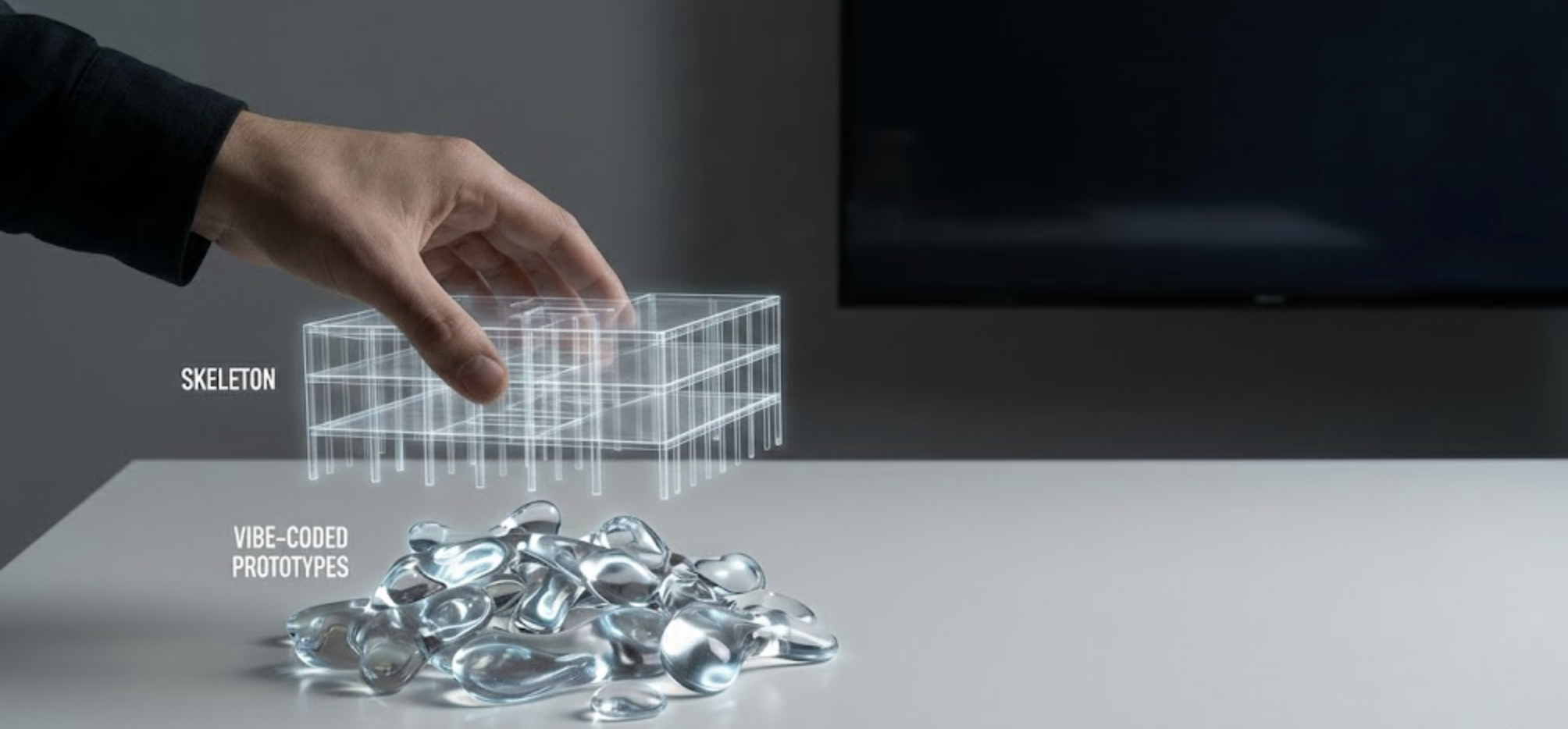
AI can give us the Skin, aka the execution and the speed. But the Skeleton, the intent, the ethics, and the human-to-human empathy, must be human-led.
Where I Stand
AI hasn't killed the Double Diamond; it has just made the "Deliver" phase nearly instantaneous. This makes the "Discover" and "Define" phases more important, not less.
Protect the Tension: Don't collapse your roles into a blur. The friction between Design and Engineering is where the "new" is born.
Use AI for the Momentum: Leverage AI to speed up the steps along the way: AI-moderated research (via tools like Userology) to get findings faster, or AI-assisted requirements documentation to keep alignment tight.
Build to Learn: Let AI explore the solution space at 100mph, but don't let it define the problem.
AI provides the variation. Product Thinking provides the selection pressure. If you can’t tell the difference, you aren’t leading.
